Waar vindt u het chassisnummer van uw Holtkamper?

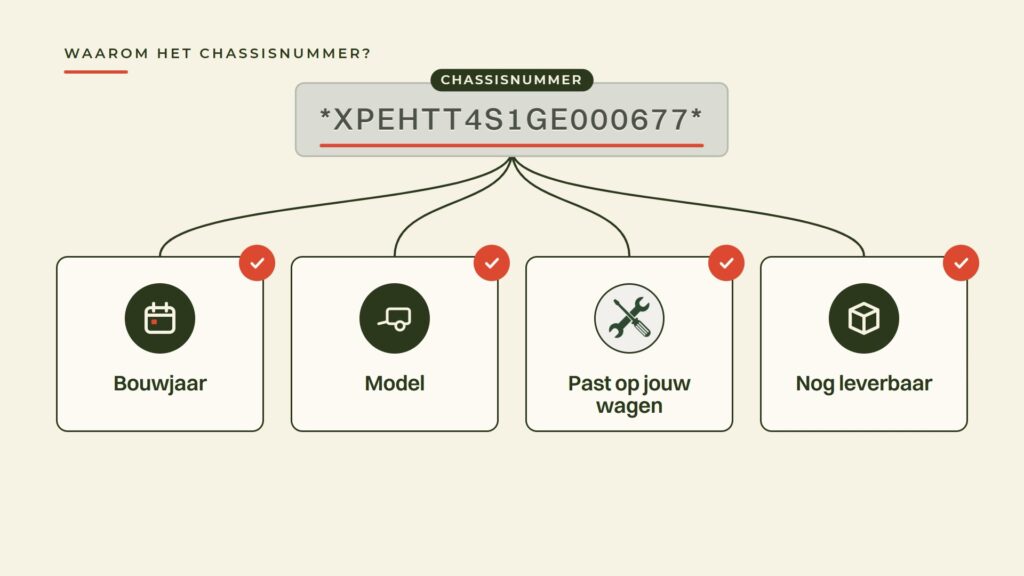
Wilt u onderdelen bestellen voor uw Holtkamper of een serviceafspraak inplannen? Dan vragen we u om het chassisnummer van uw vouwwagen. Met dit unieke nummer kunnen we achterhalen welk model u heeft, uit welk bouwjaar uw vouwwagen komt en welke onderdelen daarbij passen. Maar waar vindt u dit nummer eigenlijk? We leggen het u uit!

Waarom hebben we uw chassisnummer nodig?

Iedere Holtkamper heeft een uniek chassisnummer. Dit nummer geeft ons belangrijke informatie over uw vouwwagen, zoals het model en het bouwjaar.

Door de jaren heen zijn onze vouwwagens voortdurend verder ontwikkeld en verbeterd. Hierdoor kunnen onderdelen per model en bouwjaar verschillen. Een onderdeel dat op een oudere Holtkamper past, is dus niet altijd geschikt voor een nieuwer exemplaar.

Met behulp van uw chassisnummer kunnen onze specialisten controleren welke onderdelen geschikt zijn voor uw vouwwagen en of deze nog leverbaar zijn. Zo kunnen we u sneller en gerichter helpen.

Waar staat het chassisnummer van uw Holtkamper?

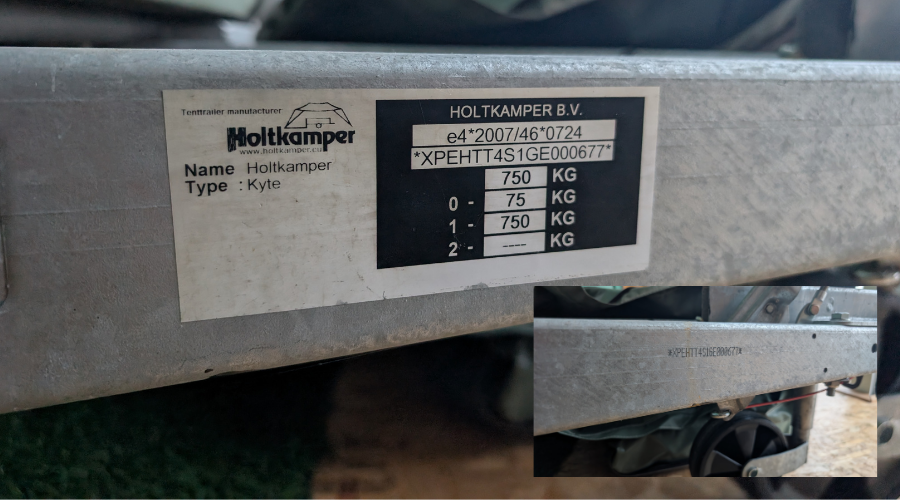
Het chassisnummer vindt u aan de voorkant van uw vouwwagen, op de dissel. Dit is het V-vormige gedeelte waarmee u de vouwwagen aan uw auto koppelt.

Het nummer staat op het rechter chassisdeel, gezien in de rijrichting. Dat betekent rechts wanneer u vanuit de auto naar voren kijkt.

Het chassisnummer is in het metaal aangebracht en kan zowel aan de zijkant als bovenop het rechter chassisdeel staan.

Kunt u het nummer niet direct vinden? Bij oudere vouwwagens kan het nummer wat vervaagd zijn of bedekt zijn met vuil. Vaak helpt het om het chassisdeel voorzichtig schoon te maken.

Tip: Maak meteen een foto van het chassisnummer zodra u het gevonden heeft. Zo heeft u het altijd bij de hand wanneer u onderdelen nodig heeft of contact opneemt met onze serviceafdeling.

Onderdelen bestellen voor uw Holtkamper

Heeft u een onderdeel nodig voor uw Holtkamper? Via onze website kunt u eenvoudig een onderdelenaanvraag indienen.

Ga naar Service en onderhoud en kies vervolgens Onderdelen. Vul het aanvraagformulier in en vermeld daarbij het chassisnummer van uw vouwwagen.

Onze specialisten kijken vervolgens welk onderdeel geschikt is voor uw Holtkamper en of het nog leverbaar is.

Neemt u liever telefonisch contact met ons op? Houd dan uw chassisnummer bij de hand. Zo kunnen we u sneller helpen en voorkomen dat u een verkeerd onderdeel bestelt.

Bekijk de onderdelenpagina en dien uw aanvraag in

Dit moet je weten over je Holtkamper bij storm

Ook tijdens een zonnige kampeervakantie kan het weer plotseling omslaan. Harde wind, stevige regenbuien en onweer kunnen snel opkomen. Maar wat moet je doen als je met jouw Holtkamper in een storm terechtkomt?

Geen zorgen: een Holtkamper is goed bestand tegen harde wind. Het is wel belangrijk dat je de luifel op de juiste manier voorbereidt. In deze blog en video leggen we uit wat je moet doen en welke onderdelen je juist niet moet gebruiken.

Bekijk de video

In onderstaande video laten we stap voor stap zien hoe je jouw Holtkamper voorbereidt op harde wind.

Verwijder de zijwanden bij wind op de voorkant

Staat de wind vol op de voorkant van de Holtkamper en heb je geen voorwand geplaatst? Verwijder dan als eerste de zijwanden.

Wanneer de zijwanden blijven zitten, kan de wind zich onder de luifel ophopen. Door de zijwanden weg te halen, geef je de wind ruimte om te ontsnappen en voorkom je onnodige druk op de luifel en het tentdoek.

Bevestig de stormelastieken

Bevestig vervolgens de meegeleverde stormelastieken aan de groene lusjes van de luifel. Zet ieder stormelastiek vast met een stevige haring die geschikt is voor de ondergrond waarop je kampeert.

De stormelastieken zijn speciaal ontworpen om de luifel te ondersteunen zonder deze volledig vast te zetten. Dankzij de elasticiteit kan de luifel tijdens harde wind blijven meebewegen.

Dat is precies wat je wilt: meebewegen met de wind in plaats van de wind tegenhouden.

Gebruik geen vaste scheerlijnen

Gebruik bij je Holtkamper geen vaste, niet-elastische scheerlijnen om de luifel strak naar beneden te trekken. Deze lijnen geven niet mee en kunnen daardoor te veel spanning op het tentdoek, de naden en de constructie zetten.

Een stormelastiek vangt windvlagen geleidelijk op. Hierdoor wordt de kracht beter verdeeld en kan de luifel op een gecontroleerde manier bewegen.

Ook bij twijfel: stormelastieken plaatsen

Ga je een dag op pad en vertrouw je de weersvoorspelling niet helemaal? Plaats dan voor vertrek alvast de stormelastieken.

Het weer kan op de camping snel veranderen, ook wanneer er bij vertrek nog weinig aan de hand lijkt. Door de elastieken preventief te bevestigen, verklein je de kans dat je bij terugkomst voor verrassingen komt te staan.

Controleer daarnaast of losse kampeerspullen, stoelen en andere voorwerpen veilig zijn opgeborgen.

Wel een voorwand geplaatst?

Met de voorwand geplaatst is je Holtkamper nog beter beschermd tegen harde wind. Gebruik de luifelstok daarom alleen in combinatie met de voorwand. De voorwand en luifelstok vormen samen een stevigere constructie.

Blijf ook met de voorwand altijd de stormelastieken gebruiken. Deze vangen windvlagen op en zorgen ervoor dat de luifel kan blijven meebewegen.

Kort samengevat

Staat er harde wind of wordt er storm voorspeld?

  • Verwijder de zijwanden wanneer de wind vol op de voorkant staat en er geen voorwand is geplaatst.
  • Bevestig de stormelastieken aan de groene lusjes van de luifel.
  • Gebruik stevige haringen die passen bij de ondergrond.
  • Gebruik geen vaste scheerlijnen.
  • Plaats geen luifelstok zonder voorwand.
  • Met voorwand is je Holtkamper nog beter stormbestendig. Maak ook hier gebruik van de stormelastieken.
  • Bevestig de stormelastieken ook preventief wanneer je een dag weggaat en het weer niet vertrouwt.

De belangrijkste regel is eenvoudig: laat de luifel meebewegen met de wind en probeer hem niet volledig vast te zetten.

Carefree travel with good trailer insurance

At Holtkamper everything is about carefree camping. For almost 100 years we have been building trailer tents known for quality, comfort and ease of use. But good camping does not stop with a strong trailer tent alone. Also on the road you want to be able to rely on good service and clear agreements if something happens.

That is why we work together with I Love Camping. A party that, like Holtkamper, understands what makes camping special. No complicated insurance talk, but clear conditions, flexibility and attention to the practice of camping life.

Whether you hit the road with a new Holtkamper or have been enjoying an older trailer tent for years: it is nice to know that everything is well taken care of. Especially when quality, trust and personal service are paramount.

The I Love Camping Trailer Insurance

With the I Love Camping trailer tent insurance you put together what you want to insure. That way you only pay for what suits your situation.

Do you vacation mostly in the Netherlands? Or do you travel all over Europe? Do you only want basic coverage for fire and theft, or would you rather have comprehensive all-risk insurance including accessories and contents? It’s all possible.

The insurance policy is designed specifically for campers and therefore fits well with how a trailer tent is actually used.

The benefits at a glance

Up to 20% no-claims discount

Have you camped claim-free for years? Then you will be rewarded for this with an attractive no-claims discount of up to 20%.

Up to 7 years new value possible

If you choose the Optimaal coverage, you can insure your trailer tent for up to 7 years at new-for-old value. This provides extra security if your trailer tent is totaled or stolen.

Inexpensive basic coverage

Also with basic insurance, you are well protected against such things as:

  • Fire
  • Theft
  • Storm damage
  • Liability
  • Damage assistance

Up to 20% discount for Netherlands coverage

Do you only camp within the Netherlands? Then you can benefit from additional premium discounts.

No deductible through affiliated partners

If you have damage repaired through an affiliated partner in the I Love Camping Network, such as Holtkamper in Utrecht, you do not pay any excess. Normally this is €150 per claim.

Insure Without Hassle

At I Love Camping they understand that insurance is not the most fun part of camping. That’s precisely why they keep it simple and straightforward.

Their vision fits well with Holtkamper’s: camping should above all remain fun. Even when the going gets tough.

Not only new trailer tents are welcome. Older models or self refurbished trailer tents can also be simply insured. In many cases this is done on a daily value basis, where accessories and improvements can be additionally insured.

Frequently Asked Questions About Trailer Insurance

What happens if I am unable to continue traveling after storm or hail damage?

If your Holtkamper can no longer be used safely due to damage, the insurance offers assistance. Think of salvage, transport or repair so you can continue your trip or get home safely.

My Holtkamper is older and refurbished by myself. What value do I insure?

In that case, the daily value of comparable trailer tents is usually considered. Accessories and improvements can often be additionally insured.

When do I not pay a deductible?

Have your damage repaired at Holtkamper in Utrecht, affiliated partner of I Love Kamperen, then you do not pay a €150 excess. Other affiliated repair partners can be found on the website of I Love Camping.

What does up to 7 years new value mean?

With Optimaal coverage, in the event of theft or total loss, the new value of your trailer tent is assumed, rather than the lower current market value. This is possible up to a maximum of 7 years after purchase.

Can I take claim-free years with me?

Yes, claim-free years from a previous caravan or trailer insurance policy can usually be taken into account. This allows you to build up no-claim discount immediately.

Arrange Your Trailer Insurance

Want to send your Holtkamper on the road properly insured? Then simply check out the I Love Camping trailer tent insurance options via the link below:

Arrange Your Trailer Insurance Here

The right insurance will make your trip just that little bit more relaxing. And in the end, that’s what camping is all about.

Holtkamper for Dummies

At Holtkamper, we love camping, innovation, comfort and… cryptic English terms!

But what does that “WindForce” System really mean? Or “Pack N GO…”? No, we don’t have a packing service, unfortunately…. 🙂

Below you will find our typical Holtkamper names, translated into clear and understandable Dutch. In other words: Holtkamper for Dummies!

Tent trailer: Folding trailer (or folding cart).

Photo credits: add Wilmar Zomer
Photo credits: Wilmar Zomer

WindForce: Automatic system that sets up the trailer tent in under 15 minutes, without loose poles or guy ropes. Basically an inflatable trailer tent.

Pack N Go: The system to easily pack and unpack the trailer tent at home, without having to unfold the whole trailer tent. Ideal when there is limited space at home to set up the whole trailer tent.

Holtkamper PacknGo

Membrane Airco tent system: The double roof of our trailer tents. Here the inner layer is fitted with breathable (membrane) material. This creates better insulation and more air circulation for a more pleasant indoor climate in the tent.

All Climate® windows: These are the windows in the Holtkamper, Standard equipped with mosquito netting on the outside, clear plastic windows and curtains. The windows can be opened on the inside in different positions. A trailer tent with good ventilation and lots of light, adaptable for every season.

MTT: This stands for “Multi talent trailer…” well that doesn’t make it any clearer either.

Originally the name for a folding trailer with a longer chassis, the rear part of which could be used for anything. Multi talent so to speak. We now only put kitchens on the back of it, but never changed the name to Single Talent Trailer.

So now just say “with kitchen.” So an Aero MTT, is an Aero folding trailer tent with luxury kitchen. So for the observant reader, the Aero WindForce MTT is an inflatable Aero with luxury kitchen.

Holtkamper Aero MTT

Sunrise Canopy: This is an additional feature to the awning on some Cocoon models. By adding an extra pole to the middle awning pole that is adjustable in height, the front part of the awning can also be pulled up or down. You then create a kind of awning on your awning.

Hub chub system: A lever system in the trailer tent like in the frame of our Holtkamper Aero and Kyte. To manually erect the folding trailer without too much force.

No Pole Awning: The well-known and now very recognizable floating canopy without upright poles of the Holtkamper Aero, Kyte and Nano.

Bisonyl: Bisonyl is a strong and waterproof PVC-coated cloth, It is used for a variety of applications such as truck tarps, tarpaulins because of its high strength, durability and abrasion resistance. So ideal for use of our green Softtops.

Bisonyl Holtkamper

Soft top: A trailer tent with a tarpaulin. At Holtkamper this is the soft green Bisonyl tarpaulin used to close the Holtkamper Cocoon, Aero and Kyte. The advantage of this is that more luggage can be carried because of space under the Softtop.

Holtkamper soft top

Hard top: A folding trailer with hard top / bottom like the Holtkamper Nano and Astro. The advantage of this is that there is no direct contact with the ground and also no ground sheet that you have to clean and let dry thoroughly before packing the wagon.

Hard top

Holtkamper Cocoon Modular: A reconditioned Holtkamper Cocoon. This involves overhauling a used chassis and tent frame and making it technically sound again. The reconditioned vehicle is then fitted with a new cockpit, soft top and new tent so that it can last for years again.

Bonus question: What is a Softtop Holtkamper Cocoon Windforce Modular MTT with Sunrise system 🙂 ?

How fast can you drive with a folding trailer?

One of the most frequently asked questions by campers: how fast can you drive with a trailer tent behind the car?

The answer is a little more winding than initially expected, because it depends on the country you are driving in, the weight of your combination and sometimes even the technical condition of the trailer tent. In this blog, we explain it clearly for you, so that you are well prepared to hit the road.


In the Netherlands: maximum 90 km/h

In the Netherlands, a speed limit of 90 km/h applies to cars with a folding trailer (or trailer).

So that’s always the limit, even if your trailer is light and your car could effortlessly handle more.

The reason? Safety! A trailer (or folding trailer) affects the handling of your car because of its extra length and weight. The extra weight makes the braking distance longer. Wind sensitivity is also higher.

Also pay attention at route controls! Some section controls also register driving with a trailer. The section control may indicate 100km/h, but for driving with a trailer, 90km/h remains the speed limit.

💡 Tip: Always make sure the drawbar pressure is set properly and your trailer is loaded properly. Improper distribution can cause swaying at higher speeds. The maximum nose weight of our Holtkamper trailer tents is 75kg (except the Offroad models).

Abroad: different rules

Are you crossing the border with your Holtkamper? Then the rules change.
Each country has its own speed limits for combinations with trailers or caravans. Below is a handy list of the most popular camping countries:

Country Maximum speed with trailer Remarks
Netherlands 90 km/h Always 90 km/h, regardless of weight

Pay attention at speed checks

Germany 80 km/h (standard) / 100 km/h (with TÜV approval) Only with special 100 km/h approval
France 130 km/h on highways, but 110 km/h with trailer > 750 kg In rain: max. 100 km/h
Belgium 120 km/h Only if total weight of car + trailer < 3.5 tons
Switzerland 80 km/h standard / 100 km/h with approved combination Strict controls on speed and weight. Speed 100 permitted only with technically approved combination up to 3,500 kg
Italy 80 km/h on highways, 70 km/h on secondary roads High fines if exceeded

The ANWB recommends a 70 and 80 km sticker

Spain 90 km/h on highways, 80 km/h on secondary roads
Denmark 80 km/h (100 km/h with approved combination) Sticker required at 100 km/h inspection
Sweden 80 km/h
Norway 80 km/h


Germany: the “Tempo 100” scheme

Do you often drive to Germany? Then you can have your trailer tent inspected for 100 km/h.
This inspection must be requested in person and is conducted by organizations such as TÜV NORD or DEKRA in the Netherlands.

For this, you must meet a number of conditions, such as:

  • Your trailer tent must have an overrun brake and shock absorbers.
  • The tires must be less than 6 years old and suitable for higher speeds (minimum speed index L = 120 km/h).
  • Your car must be powerful enough and equipped with ABS.

After approval, you will receive a “Tempo 100” sticker that must be placed clearly visible on the back.For the placement of this sticker, we can mount an aluminum plate on the back of the Holtkamper.

Please note that without this sticker, the 80 km/h limit automatically applies.

Switzerland: pay extra close attention to the rules

Are you heading for the Alps with your Holtkamper? Then it is good to know that Switzerland strictly controls speed and weight of combinations with a trailer or folding trailer.

The standard speed limit in Switzerland is:

  • 80 km/h on freeways and expressways
  • 80 km/h outside the built-up area
  • 50 km/h within the built-up area

The same goes for light folding trailers.

Tempo 100 in Switzerland

As in Germany, in Switzerland there is a possibility to drive 100 km/h with an approved combination. For this, both the car and the trailer must be technically suitable and approved.

Conditions include:

  • The total combination may weigh up to 3,500 kg
  • Both car and trailer must be technically approved for 100 km/h

This approval allows you to drive on highways and freeways at a maximum speed of 100 km/h.

💡 Please note: Switzerland strictly controls speeding. Fines can be substantial, even for minor overruns.

Why those limits are important

A folding trailer weighs less than a caravan, but it is still a trailer.
At higher speeds, the risks increase rapidly:

  • The braking distance becomes longer.
  • The likelihood of swaying due to wind or traffic increases.
  • Tires heat up faster and can blow if overloaded or improperly inflated.

In short: it is not just about what is allowed, but also about what is safe.


Practical tips for safe driving with your Holtkamper

✅ Check tire pressure: too low pressure causes instability and wear.
✅ Distribute the weight well: heavy stuff at the bottom, as close to the axle as possible.
✅ Check the clutch and lights before departure.
✅ Schedule extra travel time: quieter driving is more relaxing and safer.


Conclusion: take your time, enjoy the ride

Whether you’re driving to the Veluwe or to the south of France, with a Holtkamper your vacation begins on the road. Drive slowly, observe the speed limits of the country you are in and make sure everything is properly adjusted. This way you will arrive at your destination safe and relaxed.

Want to know more?
At our showroom in Utrecht we will be happy to tell you more about safe driving with your Holtkamper, from the correct tire pressure advice to tips for loading and adjusting the drawbar. Make an appointment online with our online planner, then we can help you further at your leisure.

Autumn storms? Here’s how to stay carefree camping with your Holtkamper

Fall is once again upon us. For many campers, that means shorter days, colorful forests and crisp mornings with a hot cup of coffee in front of the tent. But autumn also brings turbulent weather: wind, rain and sometimes even storms.

Fortunately, as a Holtkamper camper, you don’t have to let that stop you. Our tent trailers are designed and tested to remain reliable even in challenging conditions: from the rugged plains of Iceland to the high cliffs of Brittany. Or during a severe storm in Zeeland, as in the video below from our colleague Gert-Jan.

Yet we regularly get the question: “Now what is the best approach when the wind blows hard?”

Therefore, we have listed the most important tips and points of interest for you, so that you can enjoy your Holtkamper in autumn as well.

General storm tips for your Holtkamper

Always tension well
Make sure your Holtkamper is securely pegged all around.

Secure awning points properly
With the Aero, Kyte or Nano, always secure the awning points with at least five pegs. To do this, use the long pegs and hit the rubber bands double.

Different sizes of pegs

Wind from the front? Unzip sidewalls
Is the wind blowing and are you using the awning without the front wall? Then first unzip the side walls. This allows the wind to escape better and prevents the awning from acting like a sail.

Use storm straps
When in doubt, always do it! Attach the storm rubber bands to the green bisonyllus and secure with a sturdy peg. The elastic allows the awning to move with you and absorbs hard blows better.

No fixed guy ropes
Never use rigid guy ropes. These do not absorb impacts and can actually cause tension on the canvas – resulting in possible damage.

Front wall attached?
Do you have the front wall in the awning? The sidewalls can remain in place. Make sure that the awning with the front wall is tightened with storm straps.

If the wind really gets too strong…

Sometimes it simply becomes too much of a burden. Then it is wise to temporarily pack up the awning. There are two ways to do this:

1. Fold awning over the wagon (the quick method).

  1. Remove the front and side panels.
  2. Take out the kitchen and canopy arch.
  3. Lower the mast.
  4. Fold the awning over the wagon so that the awning tips hang over the back of the roof.
  5. Secure the awning points to the back of the wagon.

This method takes little time and is ideal if you need to act quickly.

2. Canopy rolling up and securing (the complete method)

  1. Remove the front and side panels.
  2. Take out the kitchen and canopy arch.
  3. Lower the mast.
  4. Roll up the awning (easiest to do with two people).
  5. Secure the roller to the front of the roof with the toggles and included green straps.

This is a slightly more elaborate approach, but ensures neat and safe storage.

Always be prepared

Whether you’re camping in the Netherlands or adventuring on the coast of Brittany, the weather can change quickly. With good preparation and the right storm tips, you can be sure of worry-free camping, even in autumn.

So put on a warm sweater, make a pot of strong coffee and enjoy the unique camping feeling your Holtkamper gives you. Because weather or no weather: your adventure never stops.

Help!!! I have a stain on my Holtkamper tent canvas

A clean tent is not only pleasant to look at and lie under, it also makes the tent fabric last longer. Especially after a vacation full of adventure, rain and nature, stains can develop on the canvas. In this blog, you’ll learn how to safely and effectively remove stains from both uncoated and coated TenCate tent fabric, and what to absolutely avoid.

Coated vs uncoated tent fabric

Holtkamper folding trailers come standard with uncoated TenCate tent fabric, a top-quality fabric made in the Netherlands. This breathable fabric ensures a comfortable indoor climate, prevents condensation, and contributes to the unique camping experience that Holtkamper offers.

In the past, Holtkampers were also manufactured using coated or sealed TenCate tent fabric, also known as polycotton. That is why we will cover both types in this blog post.

The difference between coated and uncoated tent fabric is easy to feel: coated fabric feels a bit stiffer and smoother, somewhat like plastic. The coating makes it waterproof, but it doesn’t breathe as well. Uncoated fabric, on the other hand, feels more natural, is more flexible, and offers an excellent balance between waterproofing and breathability. This makes it perfect for comfortable days and nights while camping.

Removing stains from uncoated TenCate tent fabric

Uncoated cloth is more fragile and difficult to clean than coated cloth. Therefore, prevention is always better than cure.

The basics

  • Never use soap-based agents.
  • Use a soft brush, not a sponge.
  • Never brush hard, as this may damage the cloth or color.
  • Gently brushing is usually enough to remove light dirt.
  • In most cases, the sun takes care of the rest!
  • If you use water, let the cloth dry thoroughly first; otherwise, you might actually rub the stain into the cloth.

Common stains

Bird droppings and berries

Let the stain dry completely and then gently scratch it off with a spoon, for example. Sunlight will cause the stains to fade over time.

Resin or candle wax

Allow to solidify first and then carefully scrape off. You can possibly use a special resin remover, for example from drKeddo. Note that this is only suitable for uncoated cloth.

Algae and mold

For uncoated cloth, do not use chlorine, which can cause discoloration. Instead:

  • Mix cleaning vinegar with water in a ratio of 1 to 1.
  • Apply the mixture with a soft brush and do not scrub hard.
  • Rinse thoroughly with clean water.

Heavily soiled cloth

Use only agents specifically for uncoated tent fabric. TenCate-tested brands include Isaclean, Deva, 123products, HG and Ultramar.

Note: Use these agents sparingly and always follow the manufacturer’s instructions for use.

After intensive cleaning, it is important to re-impregnate the fabric for continued protection.

Tip: Is the canvas heavily soiled? Then consider having your tent professionally cleaned through a reputable tent cleaning and maintenance specialist.

Stain removal on coated TenCate tent fabric

Coated tent fabric is easier to clean, but also requires careful handling.

The basics

  • Never use soap-based agents.
  • Preferably remove stains immediately with lukewarm water and a soft cloth or brush.

Common stains

Bird droppings, berries and coffee

Remove these stains as soon as possible with lukewarm water.

Resin or candle wax

Allow to solidify and gently scrape off with a spoon.

Note: Do not use resin removers on coated cloth, they can damage the coating.

Algae and mold

  • Use a light chlorine solution of 1 part chlorine to 10 parts water.
  • Let this soak in briefly.
  • Brush gently.
  • Rinse thoroughly with plenty of water.

Note: Do not use cleaning vinegar on coated canvas. This is only suitable for uncoated tent cloth.

Heavily soiled cloth

Use only cleaners specifically designed for coated tent fabric. TenCate-tested agents include Isaclean, Deva, 123products, HG and Ultramar. When using cleaning agents, always follow the manufacturer’s instructions for use. After cleaning coated fabric with these agents, re-impregnation may be necessary.

Please note that frequent use of cleaning agents can eventually affect the strength of the tent fabric. Therefore, use these agents in moderation and always consult a specialist when in doubt.

Is the canvas heavily soiled? Then you can also choose to have the entire tent professionally cleaned. Several specialists offer appropriate solutions for this.

Mold removal: here’s how to do it

Mold is usually caused by moisture and inadequate ventilation. Fortunately, it is easy to deal with.

Algae and mold can usually be removed with a light chlorine solution in the ratio of 1 to 10 of chlorine and water. If this does not work sufficiently, use a suitable cleaning agent according to the manufacturer’s instructions.

Does your tent have uncoated TenCate canvas? Then follow the instructions under the section on cleaning uncoated cloth. Note that re-impregnation is always necessary after cleaning uncoated cloth.

In conclusion

Proper maintenance keeps your Holtkamper tent canvas beautiful and strong, season after season. Are you unsure about which agent to use best? Or is the canvas seriously soiled? Feel free to contact one of our specialists. We will be happy to think along with you.

Checklist: Safe on the road with the Holtkamper

The vacation begins right in the driveway. At least, if you are well prepared. Whether you are setting off with a Holtkamper for the first time or are an experienced trailer tent camper: with this checklist, you will hit the road with peace of mind and a safe feeling.

1. Before departure – Technical inspection

A good trip starts with a thorough check. Always run through these technical points before you leave:

✔️ Tire check

  • Tire pressure at the right level? At Holtkamper it is usually 2.4 bar (also at the spare tire).
  • Profile still at least 2 mm?
  • No drought cracks or damage visible?

✔️ Lighting works properly
Check brake lights, turn signals, city lights and license plate lights.

✔️ Overrun brake and hand brake function properly
Test operation and check for wear.

✔️ Clutch and nose wheel in order

  • The correct nose weight is between 50 and 75 kg (depending on the car).
  • Nose wheel up and properly secured.

✔️Wielbouten tighten securely (using a torque wrench if necessary).

✔️Vergeet don’t attach the license plate!


2. Documents and papers

Make sure you have all the necessary papers with you; this will prevent hassles along the way.

✔️ Driving License
For driving a Holtkamper, driving license B is sufficient, due to its low weight.

✔️ License plate and NL sticker

  • Does your folding trailer have a maximum authorized mass of 750 kg or less? Then it should have a white license plate with the same number as your car.
  • For travel outside the Netherlands, it is necessary to use distinguishing mark (NL sticker). A NL sticker may not be stuck on this license plate but must be clearly visible on the back of the trailer tent

✔️ Green Card
Certificate of insurance (including for the trailer).

✔️ Hazard triangle and safety vests
Mandatory in many countries – better with than without!

✔️ Camping card (CCI)
The ANWB Camping Card or Camping Card International is convenient and often offers discounts.

✔️ Travel insurance with roadside assistance
Make sure you also have coverage for the trailer.

✔️ Type approval
The trailer tent must have a type approval. This is always regulated at the European level by the manufacturer. Therefore, check that this is clearly visible on the type plate on the drawbar. This plate must have the following information:

  • Manufacturer’s name
  • Type approval number with vehicle identification number
  • Technically maximum permissible maximum mass and axle loads


3. Cargo and Loading

  • Load evenly distributed, heavy stuff above axle and as low as possible, This provides a lower center of gravity and more stability while driving. Proper distribution of the weight affects the nose weight and handling of the trailer tent.
  • Do not exceed maximum authorized mass (750kg)
  • Nothing loose in the car that can slide while driving. For example, put tea towels on the cutlery drawer in the kitchen so it doesn’t rattle and everything stays neat and tidy while driving.


4. Attach

✔️ Plug connected
13- or 7-pin plug properly plugged in, cable not hanging over ground.

✔️ Clutch locked
Safety cable properly attached and manually check that the clutch is secure.

✔️ Handbrake released and support legs raised
Also fully screw in and secure the herring legs.

✔️ Mirrors adjusted
Ensure good visibility of the trailer on both sides.


5. Driving a folding trailer

✔️ Adjust driving behavior

  • Adhere to the speed limits for trailers (often max 90 km/h, sometimes higher on highways).
  • Keep more distance from predecessors.
  • Be alert in high winds and overtaking trucks.
  • Brake gradually – driving slowly is safer as well as more comfortable.
  • Take frequent breaks to check tires, clutch and load.


In conclusion: with this checklist you will be all set for a carefree drive to your vacation destination. Take the time for proper preparation and then enjoy the adventure all the more – with the freedom and comfort of your Holtkamper.

Safe journey! 🌍⛺

Here’s how to prevent damage to your Wind®Force system

At Holtkamper, we pride ourselves on the innovative design and quality of our trailer tents. Still, we occasionally see damage pass by in the workshop that could easily be prevented with a little extra attention. Therefore we have listed the most common mistakes when folding the Aero or Kyte with Wind®Force system. A handy checklist before you hit the road!

General points of interest before departure

  • Don’t forget the handbrake

It may seem obvious, but unfortunately it is common for the handbrake to be accidentally left on while driving. This causes considerable overloading and can lead to damage to the brake drums. So: always check the handbrake before leaving.

  • Check tire pressure

Too low or too high tire pressure can be dangerous and cause extra wear and tear. The correct pressure for your Holtkamper wheels is 2.4 bar and is indicated on the hubcaps. Just check before you leave!

Wind®Force: making it work even smoother

While unfolding:

  • Attaching ground sheet to peg legs: Always make sure the corners of the ground sheet are securely attached to the peg legs before inflating or collapsing. This will prevent the tarp from shifting or being damaged. When setting up and taking down, check that the fasteners are securely fastened so that the tarp stays neatly in place:

Corner groundsheet Corner groundsheet 2

  • Use lashing strap: Always use the black ratchet tension strap on the back of the cart and tighten it properly. This ensures stability and prevents skewing of the system. This ensures proper distribution of forces and better control over the tension and height of the awning:

Tension band 2

During folding:

  • Reattach ground sheet to peg legs: Reattach the corners of the groundsheet to the peg legs before folding the cart. This prevents the tarp from shifting or damaging during folding.
  • Guiding the frame: Do not let the frame “fall free” when folding. Guide the process and keep the frame as straight as possible. This prevents buckling or warping:

Supervise Supervise 2

  • Mast foot correctly in transport position: put mast foot or ‘stump’ in upper position for folding:

Transport mode 1 Transport mode 2

  • Vertical carbon frame parts down: put them in the lower position and close the red Isafix clamps. Note: The vertical parts are the only frame parts where the isafix clamps must be reattached. The rest of the frame parts must move freely for folding:

Vertically fixed

  • Allow other frame parts to move freely: For all other frame parts, click the red Isafix clips into the correct position so that they can move freely during folding:.

Isafix correct Isafix Incorrect

  • Locking herring legs: Remember to securely lock the herring legs with the lock nuts. This will prevent them from sliding or loosening during transport. The lock nuts should be screwed completely through the hole in the legs:

Herring leg incorrect Herring leg right

Bonus: a refrigerator tip for hot days ☀️

Does the temperature go above 30 degrees? Then set your refrigerator a few degrees warmer instead of colder. This may sound contradictory, but this means the refrigerator doesn’t have to work as hard. The result: better cooling performance AND less chance of ice forming:

Refrigerator 2 Refrigerator 1

What is the Wind®Force system – and why won’t you want to miss it?

Holtkamper’s patented Wind®Force system is a revolutionary solution that allows you to set up and fold down your trailer tent fully automatically in just a few minutes. The Wind®Force system is the ideal tool for setting up and taking down the trailer tent; one push of a button and manual operations are reduced to a minimum.

This system is available as standard on the Holtkamper Aero, Holtkamper Aero MTT and the Holtkamper Kyte.

Benefits of Wind®Force:

  • Super fast assembly and disassembly
  • Less physical strain
  • No risk of misalignment or misuse
  • Perfect for solo travelers or families who want to be able to move on quickly
  • Proven reliable in all seasons and conditions

This smart technology makes camping even more fun and convenient, so you can focus fully on what really matters: enjoying the outdoors.

A little attention will keep your Holtkamper in top condition

Proper preparation and awareness when setting up your trailer tent prevents problems and ensures years of camping fun. Do you have any questions or doubts? Feel free to contact us, we are happy to help you!

📧 mail@holtkamper.nl
📞 (0591) 66 89 66
🌐 www.holtkamper.nl

Tips for winter storage

[ux_image id=”972″]

Preparing for winter storage of your Holtkamper

The camping season is coming to an end, and that means your Holtkamper may soon be back in storage. With the right preparation, you can ensure that your trailer tent will be fresh and problem-free again next spring. Below you will find practical tips for getting your Holtkamper through the winter.


1. Get repairs and maintenance done on time

Would you like to have minor or major repairs done? Then arrange this before you put the Holtkamper in storage. In spring it is often busy at the service department, so you have to wait unnecessarily.
➡️ Sign up for service and maintenance can be done[here]. Don’t wait too long: the calendar fills up quickly.


2. Rinse salt and sand well

Did you camp at the coast? Then rinse the tent fabric thoroughly to remove salt residue. This will prevent deterioration of the material.


3. Make sure the cloth is clean and dry

Prevent mold and nasty odors:

  • Let the tent fabric dry thoroughly before folding.

  • Loosen dirt with a soft brush or vacuum cleaner.

  • Never use soap, this will affect the impregnation.

Don’t forget the mattress! Allow this to air well, as moisture absorbed overnight can fester with prolonged storage.


4. Clean the outside as well

Before collapsing the Holtkamper for the winter, clean and dry the outside as well. A damp cloth or a mild soak with the garden hose will suffice.


5. Pay attention to tire pressure

During the winter, tire pressure slowly decreases.
➤ Therefore, pump an additional 0.5 to 1 bar into the tires before storing the trailer tent.
➤ In the spring, return the pressure to the correct level (see manual).


6. Remove gas cylinders from the car

Always remove gas cylinders before winter storage.
Store them upright, in a cool, dry place – outside the vehicle.


7. Store guy ropes and rubber bands separately

Guy ropes and guy ropes can retain moisture. Remove them from the tent and store them loose to prevent mold and wear.


8. Empty the trailer of sensitive items

Do not leave products that may spoil, freeze or leak:

  • Food and drink

  • Liquids from the chemical toilet

  • Water bottles or storage vials

Also remove all batteries from devices such as pumps, flashlights and radios. Batteries can leak, damaging equipment beyond repair.


Ready for winter – ready for spring

These simple steps will ensure that your Holtkamper makes it through the winter in top condition. And in the spring? Just get in, unfold and enjoy.

Let me know if you also want this text as a flyer, mail or checklist!

Nieuwsbrief

Ontvang het laatste nieuws als eerste.

Door je te abonneren ga je akkoord met het ontvangen van e-mails van ons en accepteer je onze privacy policy